


UV Inks
UV inks and varnishes were first introduced to the Graphic Industry in the early 1970s. However, it is only over the last twenty or so years that their use has become widespread.
UV technology provides some considerable technical advantages for the printer, whatever the type of printing process employed (offset, letterpress, flexo, waterless, varnishing, serigraphy, etc.).
• Productivity gains due diate drying under the Ultra Violet radiation, enabling all types of overprinting or cutting and folding operations to be carried out immediately after printing.
● High print quality (excellent gloss, good physical and chemical resis- tance).
● Clean technology without any VOCs (Volatile Organic Compounds), thereby preserving the environment.
This article outlines the key points of this technology:
● Formulation
● Drying
● Ink profile
● Properties required of UV inks
● Health and safety
● Troubleshooting
Formulation
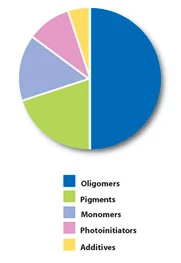
● Whatever the printing method used, UV inks are formulated from the following components:
Component | Content | Principal functions |
Oligomers | 40 - 50% | Reactive substances that determine the principal properties of the ink (press stability, printability, resistance, etc) |
Pigments (organic or mineral) | 15 – 20% | Colouring materials chosen as a function of the applications and fastenesses required. |
Monomers | 5 – 20% | Reactive diluents enabling the viscosity to be adjusted. They influence the final properties of the ink film. |
Photoinitiators | 5 – 12% | UV radiation sensitive constituents, which initiate the polymerisation reaction of the ink film. |
Additives | 1 – 8% | Products that influence specific properties, such as the rheology, adhesion, rub resistance, etc. |
● UV inks do not contain any volatile materials. Unlike conventional inks, 100% of the ink deposited on the substrate remains in the dry ink film.
Typical UV ink formulation
Drying
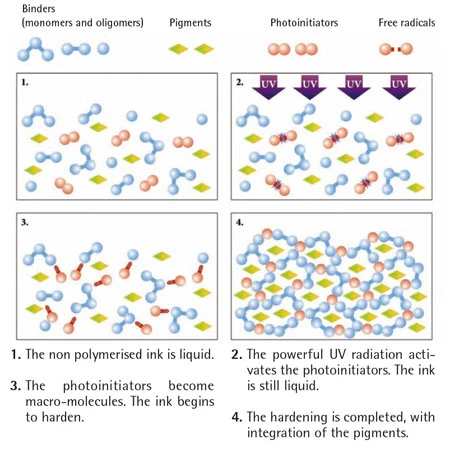
UV inks dry through a chemical poly- merisation reaction initiated by expo- sure to UV radiation. This reaction, which occurs in a fraction of a second, can be broken down into several diffe- rent steps. The fluid ink (once printed) is exposed to UV radiation (by way of passing under fitted UV lamps within the printing process). This exposure creates the chemical reaction sensiti- sing the photoinitiators in the ink. The photoinitiators generate reaction spe- cies known as free radicals, which pro- pagate the reaction. The free radicals set off a chain reaction between the oligomer and monomer binders in the formulation. The liquid ink hardens. At the end of the reaction, a solid network is formed integrating the pigment.
Process for UV curing
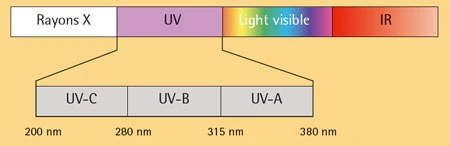
Like any other form of light radiation, UV radiation may be characterised by its wavelength (λ). The UV radiation spectrum is situated in a range of wavelengths shorter than visible light, and may be broken down into 3 parts:
● UV-C (200-280 nm) activate the photoinitiators and assure surface drying.
● UV-B (280-315 nm) maintain the polymerisation reaction.
● UV-A (315-380 nm) assure in-depth drying.
Electromagnetic spectrum
● UV lamps emit in different UV ranges in order to have maximum drying efficiency.
Precautions
Whatever the type of dryers or inks used, it is vital to check the compatibility of the following parameters when printing:
● The power rating, nature and condition of the lamps.
● The printing speed.
● The amount of ink deposited.
If the inks do not dry correctly, several actions may be taken:
● Check the efficiency of each lamp and its number of hours of use (simple equipment is available for checking the condition of UV lamps).
● Slow down the printing speed.
● Add 1 to 3 % UV Photoinitiator to the ink.
Ink profile
The performance of ink ranges are described according to 6 criteria graphically represented by the ink profile. Each criterion is assigned a simple rating between 1 and 6:
● 1 = average to low performance.
● 6 = excellent performance.
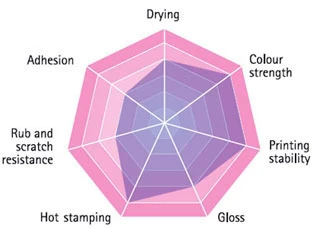
By visualising the technical profile of a range, the printer can predict the behaviour of the ink on the press as well as the qualitative results of the print, providing a suitable substrate has been chosen.
Definitions of ink performance criteria:
Drying: Ability of an ink to dry under UV light, i.e. ability of the ink to be printed at high speed without causing drying problems.
Adhesion: Ability of an ink to adhere to synthetic substrates.
Colour strength: Ability of an ink to obtain maximum optical density with a minimum amount of ink.
Gloss: Intensity of light reflected by the dry ink film (very dependent on the surface condition of the substrate).
Rub / scratch resistance: Ability of the dry ink film to withstand rubbing and physical aggressions.
Press stability: Ability of the ink to conserve all of its properties (rheology, transfer, etc.) during a print run.
Overprinting: Ability of an ink to receive a thermal transfer, hot stamping, lamination, laser printing, etc.
Required properties of UV inks
Properties of UV Offset inks |
• Water / ink balance: UV offset inks are formulated so that the water / ink emulsion is similar to that of a conventional offset ink to obtain the clearest dots and optimum sharpness. • Misting: the ink must not splatter when it is transferred on the rollers.
• Colour strength: the formulation of the binder must enable optimum development of the pigment in order to obtain the best print rendering.
• Rheology: UV offset inks must have a suitable rheology – supple to avoid them “sleeping” in the ink duct and fluid on the press to optimise the water / ink emulsion and the dot sharpness. The rheology also influences the transfer.
• Tack: the tack represents the splitting force necessary to deposit the ink film on the substrate. It has to be as low as possible to avoid any problem of pick up from the substrate or causing the registers to be out of sync.
• Shelf life: UV inks have a limited lifetime, depending on their formulation and the storage conditions. It is recommended to store them between 5 and 30°C protected from light. Brancher UV offset inks are guaranteed for 12 months.
• Drying: UV offset inks have to be very reactive to be able to dry completely at high printing speeds.
|
Properties of UV Waterless inks |
• Colour strength.
• Rheology: UV waterless inks have to be supple to ensure good transfer in the set of rollers but viscous enough to avoid plate tinting.
• Press behaviour: UV waterless inks are formulated to enable easy differentiation between the printing and non-printing (siliconised) areas of the plate.
• Tack: as low as possible, as for UV offset inks. • Shelf life: Brancher UV waterless inks are guaranteed for 12 months.
|
Properties of UV Flexo inks |
• Colour strength.
• Rheology: the rheology of UV flexo inks must be similar to that of conventional flexo inks (either water or solvent based). They have to remain fluid, whatever the temperature, the stand time and the printing steps (in the ink duct, on the anilox roller, on the plate, before drying, etc.).
• Press behaviour: low foaming, easy to pump, good transfer onto the plate, etc.
• Shelf life: Brancher UV flexo inks are guaranteed for 12 months.
• Drying: UV flexo inks have to be quite reactive so as to dry in a single passage under a UV lamp but not too much so to avoid any phenomenon of curling.
|
Properties of UV Letterpress inks |
• Colour strength.
• Rheology: UV letterpress inks must not be too firm so as not to “sleep” in the ink duct, nor too fluid so as not to block the screen.
• Tack: as low as possible, as for UV offset inks.
• Shelf life: Brancher UV letterpress inks are guaranteed for 12 months.
• Drying: UV letterpress inks have to be quite reactive to dry in a single passage under a standard UV dryer.
|
Properties of UV Varnishes |
• Gloss.
• Physical and chemical resistance: UV overprint varnishes must be able to resist all types of physical (scratching, abrasion, rubbing) and chemical (solvent, thinner) aggressions.
• Shelf life: Brancher UV varnishes are guaranteed for 12 months.
• Drying: UV varnishes have to be completely dry after passing under a UV dryer whatever the weight of film deposited.
|
Health and safety
Due to their specific formulation, precautions need to be taken when handling and using UV inks. The oligomers and monomers that are the major constituents of UV inks and varnishes are more or less irritant for the skin (Xi symbol on the labels). On the other hand, once dried, UV inks no longer present any handling risk.
Precautions to take when handling UV products | ||
Products | Possible effects | Precautions |
UV inks and UV overprint varnishes | Prolonged contact with the skin may cause irritation. Splashes in the eyes may cause irritation. | Do not use solvent to clean the ink. Wash with soapy water for 15 minutes. In case of eye contact: wash with water and look for medical advice. |
Cleaning solvents | Degreasing action on the skin. | Wear gloves and use protective cream. |
Precautions to take when printing with UV products
● Ultra Violet radiation with wavelengths less than 220 nanometers produces ozone. An over-concentration of ozone can cause a stinging sensation in the eyes and headaches.
The ozone produced must be evacuated.
In all UV drying installations, the ozone is evacuated to the exterior of the workshop by the same ventilators used to cool the lamps. It is therefore vital to check that these ventilators are working correctly.
● UV lamps act as generators of heat. Avoid any contact with the drying system, which can cause serious burns.
● In the same way, avoid any visual contact with the UV radiation, which can cause burns to the eyes.
Troubleshooting in UV offset printing
Incidents
1. Misting (ink splatter)
2. Picking substrate
3. Insufficient drying
4. Poor ink transfer
5. Poor adhesion to the substrate
Polymerisation of the inks in their container
Probable causes and remedies
1. Misting (ink splatter) (back to incidents)
Cause | Too much ink on the rollers. |
Remedie | Reduce the inking. |
Cause | Rollers incorrectly adjusted. |
Remedie | Check the pressures (reduce if necessary). |
Cause | Incorrect pH or imbalance in the fount solution. |
Remedie | Check the fount solution and correct if necessary. |
Cause | Temperature of inking rollers too high. |
Remedie | Lower the temperature of the printing units or renew the ink |
Cause | Too much water in the ink. |
Remedie | Reduce the amount of dampening if possible. |
Cause | Unsuitable ink. |
Remedie | Consult the supplier. |
2. Picking substrate (back to incidents)
Cause | Ink too “sticky” or “tacky” for the substrate used. |
Remedie | réduReduce the stickiness or tack of the ink (add UV Tack Reducing Paste or UV Thinner |
Cause | Paper coating too fragile. |
Remedie | Change the paper. |
Cause | Unsuitable blanket lining. |
Remedie | Adapt the linings as per the manufacturer’s recommendations. |
Cause | Substrate temperature too low. |
Remedie | Store the substrate at the same temperature as the print shop and follow the recommendations of the substrate manufacturer. |
Cause | Unsuitable colour sequence. |
Remedie | If possible, do not apply the densest colours on the first printing |
3. Insufficient drying (back to incidents)
Cause | Too much water in the water / ink balance. |
Remedie | Adjust the amount of fount solution. |
Cause | Unsuitable ink. |
Remedie | Consult the supplier. |
Cause | Printing speed not adapted to the number and power rating of the UV lamps. |
Remedie | Reduce the printing speed while maintaining the same output |
Cause | Unsuitable dryers sequence. |
Remedie | Adapt the sequence to suit the print run. |
Cause | High inking levels. |
Remedie | Reduce the inking levels or adapt the colour. |
Cause | The dryer requires maintenance. |
Remedie | Check the condition and efficiency of the lamps, the number of |
Cause | Too much water in the ink. |
Remedie | Reduce the dampening if possible. |
Cause | Unsuitable ink. |
Remedie | Add Photoinitiator to the ink in the recommended proportions. |
Specific cases: Drying of black. | |
Remedie | Use iron doped lamps. |
Specific cases: Drying of white. | |
Remedie | Use gallium doped lamps. |
4. Poor ink transfer (back to incidents)
Cause | Dirty or badly cleaned rollers. |
Remedie | Clean or deglaze the rollers. > See «UV additives». |
Cause | Rollers incompatible with the ink. |
Remedie | Check the rollers are compatible with UV inks. |
Cause | Temperature of the ink too low. |
Remedie | Store the ink at the temperature of the print shop (or use a mixer). |
Cause | Viscosity of the ink unsuited to the press |
Remedie | Add UV Thinner > See « UV additives » or consult the supplier. |
5. Poor adhesion to the substrate (back to incidents)
Cause | Too much water in the water / ink balance. |
Remedie | Adjust the amount of fount solution. |
Cause | Incorrect surface treatment or surface treatment that is out of date. |
Remedie | Check the surface tension of the substrate or consult the supplier to find out if the treatment is still valid. |
Cause | Unsuitable ink. |
Remedie | Consult the supplier. |
6. Polymerisation of the inks in their containers (back to incidents)
Cause | Inks stored at a too high temperature or in sunlight with |
Remedie | Check the storage conditions of the UV inks and how stocks are |


